'%3e%3cpath%20id='Vector'%20d='M1.4128%2011.9262C1.41282%2014.7436%202.97544%2017.355%205.62309%2019.2882C8.27016%2021.2209%2011.9616%2022.4381%2016.0706%2022.4381C20.1796%2022.4381%2023.8712%2021.2209%2026.5182%2019.2882C29.1658%2017.355%2030.7285%2014.7436%2030.7285%2011.9262C30.7285%209.10884%2029.1658%206.49732%2026.5182%204.5641C23.8712%202.63131%2020.1796%201.4143%2016.0706%201.41429C11.9617%201.41429%208.27016%202.63134%205.62309%204.5641C2.97542%206.49732%201.4128%209.10884%201.4128%2011.9262ZM3.30213e-09%2011.9262C-2.92036e-07%208.54795%201.87677%205.55016%204.78983%203.42315C7.70346%201.29573%2011.6942%200.00149393%2016.0706%200.00149355C20.447%200.00150196%2024.4375%201.29574%2027.3512%203.42315C30.2642%205.55016%2032.141%208.54793%2032.141%2011.9262C32.141%2015.3045%2030.2642%2018.3023%2027.3512%2020.4293C24.4375%2022.5568%2020.447%2023.8508%2016.0706%2023.8508C11.6942%2023.8508%207.70346%2022.5568%204.78983%2020.4293C1.87676%2018.3023%201.56291e-05%2015.3045%203.30213e-09%2011.9262Z'%20fill='%2360260A'/%3e%3cpath%20id='Vector_2'%20d='M16.0706%203.53444C14.3197%203.53444%2012.9003%204.95387%2012.9003%206.70482C12.9003%208.45577%2014.3197%209.8752%2016.0706%209.8752C17.8216%209.8752%2019.241%208.45577%2019.241%206.70482C19.241%204.95387%2017.8216%203.53444%2016.0706%203.53444Z'%20fill='%2360260A'/%3e%3cpath%20id='Vector_3'%20d='M16.0706%2014.7613C14.7098%2014.7613%2013.6066%2015.8645%2013.6066%2017.2253C13.6066%2018.5861%2014.7098%2019.6893%2016.0706%2019.6893C17.4315%2019.6893%2018.5346%2018.5861%2018.5346%2017.2253C18.5346%2015.8645%2017.4315%2014.7613%2016.0706%2014.7613Z'%20stroke='%2360260A'%20stroke-width='1.4128'/%3e%3cpath%20id='Vector_4'%20d='M20.6457%206.56543C21.4383%206.82556%2022.1674%207.15194%2022.8122%207.53541C24.5569%208.57277%2025.8005%2010.1061%2025.8005%2011.9364C25.8005%2013.7668%2024.5569%2015.3001%2022.8122%2016.3374C22.1676%2016.7207%2021.4389%2017.0469%2020.6467%2017.307C20.6467%2017.3053%2020.6469%2017.3035%2020.6469%2017.3017C20.6469%2016.8092%2020.569%2016.3349%2020.4254%2015.8901C21.0383%2015.6744%2021.5975%2015.4161%2022.0902%2015.1231C23.6114%2014.2186%2024.3879%2013.0692%2024.3879%2011.9364C24.3879%2010.8037%2023.6114%209.6542%2022.0902%208.74972C21.6042%208.46073%2021.0535%208.20518%2020.4502%207.99127C20.5778%207.56973%2020.6469%207.12274%2020.6469%206.65956C20.6469%206.62811%2020.6463%206.59673%2020.6457%206.56543Z'%20fill='%2360260A'/%3e%3cpath%20id='Vector_5'%20d='M11.4654%206.65956C11.4654%207.12606%2011.5352%207.57624%2011.6645%208.00043C11.0717%208.2124%2010.5301%208.46497%2010.0512%208.74972C8.53006%209.65418%207.75381%2010.8037%207.75379%2011.9364C7.75379%2013.0692%208.53006%2014.2186%2010.0512%2015.1231C10.5368%2015.4119%2011.0872%2015.6671%2011.6898%2015.881C11.5448%2016.327%2011.4659%2016.8029%2011.4654%2017.2972C10.6846%2017.0387%209.96588%2016.716%209.3292%2016.3374C7.58456%2015.3001%206.34099%2013.7668%206.34099%2011.9364C6.34101%2010.1061%207.58456%208.57277%209.3292%207.53541C9.96613%207.15669%2010.6851%206.83353%2011.4662%206.57501C11.4657%206.60313%2011.4654%206.6313%2011.4654%206.65956Z'%20fill='%2360260A'/%3e%3c/g%3e%3cdefs%3e%3cclipPath%20id='clip0_0_7'%3e%3crect%20width='32.3438'%20height='24'%20fill='white'/%3e%3c/clipPath%3e%3c/defs%3e%3c/svg%3e)

If the word "AI" still feels like a brand‑new, mysterious buzzword, you're not alone. But here's the truth: AI in medicine has been around for decades. Read on for a quick timeline of AI in medical history, starting in 1965.
1. 1960s – 1970s: DENDRAL and MYCIN
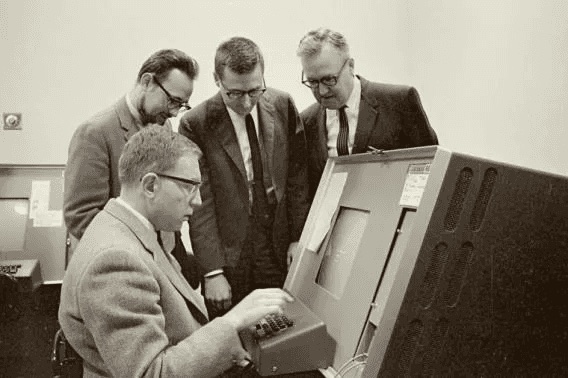
In 1965, Stanford University developed DENDRAL to assist organic chemists by inferring molecular structures from mass‑spectrometry data using a knowledge base of several hundred "heuristic" rules handcrafted by domain experts, demonstrating that rule‑based AI could tackle real‑world scientific reasoning tasks. In 1972, researchers at University of Wisconsin-Madison built MYCIN to accurately diagnose bacterial infections using similar "rules."
2. 1980s – 1990s: Statistical Models & Early Neural Networks
Hospitals like the University of Washington Medical Center began using statistical regressions to predict complications based on simple inputs like vitals and lab results. Furthermore, in 1986, researchers rediscovered "backpropagation" (a way for computer "brains" or neural networks to learn from mistakes, much like how you'd adjust a recipe after tasting soup). By feeding neural networks patient data, researchers trained their computers to estimate patient length‑of‑stay and readmission risk.
3. 2010s: The Deep Learning Revolution
A major limitation to previous AI experiments was that computers simply weren't powerful enough to process and "learn from" the amount of data needed. The 2010s saw an acceleration in the world's ability to manufacture affordable GPUs. With additional processing power, computers could learn not just from enormous numeric data, but also from heavy image data.
In 2017, an image-processing algorithm at the University of Washington detected pneumonia on chest x-rays with accuracy on par with human radiologists. In 2018, Stanford researchers trained a deep neural network on more than 130,000 skin‑lesion images and achieved dermatologist‑level accuracy in identifying melanoma. By 2019, AI was screening retinal photographs for diabetic retinopathy with ophthalmologist‑matching performance.
4. 2020+: New Foundation Models & Emerging Innovations
The early 2020s saw a proliferation of specialized AI models, finetuned for specific purposes like foreign language detection, medical terminology, and much more. AI started moving out of the lab and into the hands of consumers and businesses. Hospital systems and medical service providers began abandoning old-fashioned "Speech-to-Text" dictation software in favor of end-to-end AI scribe solutions leveraging medically-tuned models.
AI in medicine didn't arrive overnight. It's the result of nearly 60 years of steady innovation, much of it driven by clinical questions and validated in real‑world settings. Today's medical AI tools stand on the shoulders of rule‑based pioneers like DENDRAL and MYCIN, early neural‑network experiments, and even advances in manufacturing that brought us increased processing power.